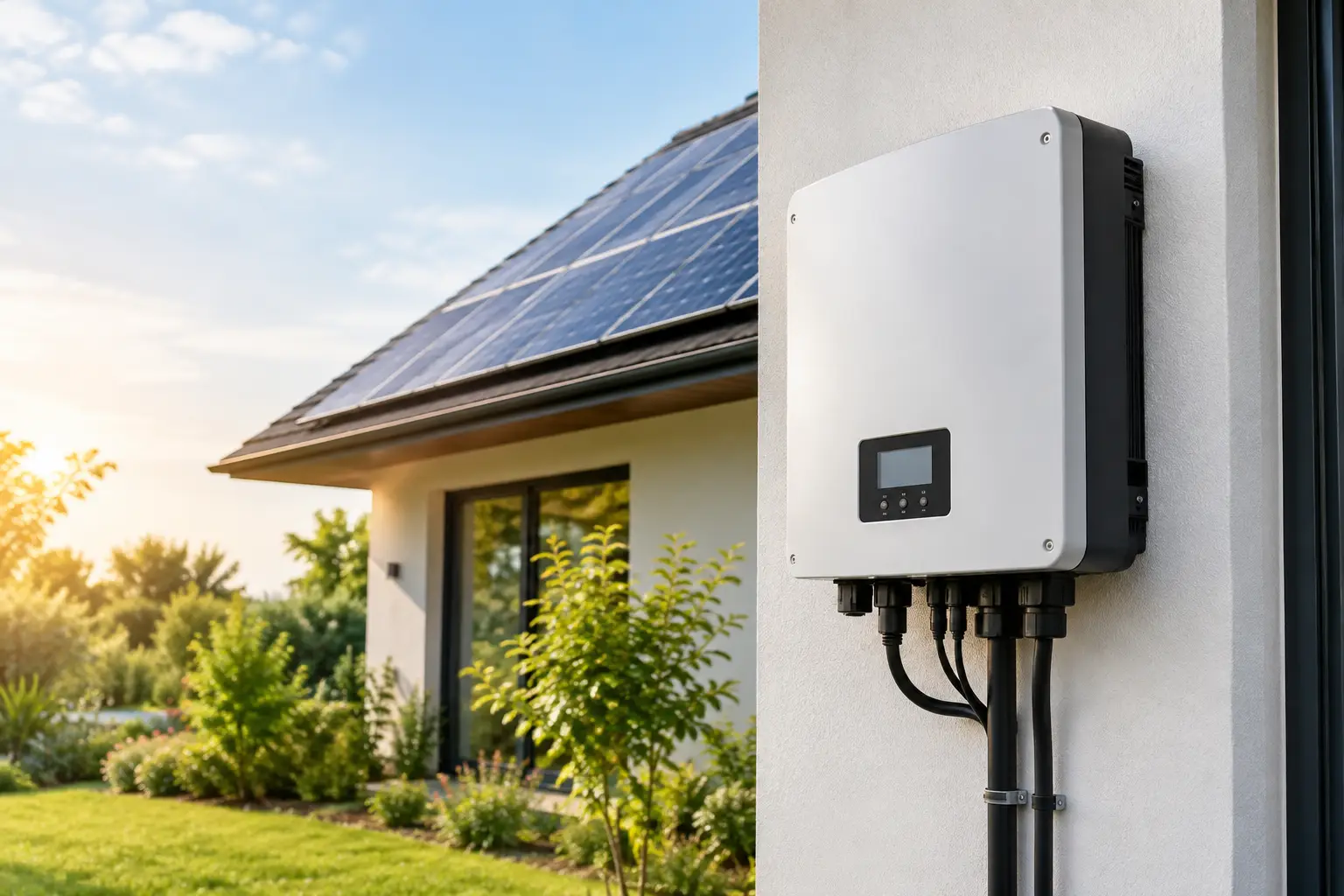
A solar panel on your roof produces direct current, but your refrigerator, lights, outlets, and utility grid use alternating current. Solar inverters handle that conversion every minute your system operates. They also do far more than translate electricity: they track production, respond to grid conditions, and can determine how well your system handles shade, battery storage, and future expansion.
For homeowners comparing solar proposals, the inverter deserves the same attention as panel wattage and total price. The right choice depends on your roof layout, local utility rules, energy goals, and whether you want backup power during an outage.
What Solar Inverters Do for a Home System
Solar panels generate DC electricity that varies with sunlight, temperature, and panel conditions. An inverter converts that DC electricity into AC electricity that your home can use. When production exceeds your household demand, the system can send excess power to the grid if your utility agreement allows it.
Modern inverters also perform safety and monitoring functions. They shut down or reduce output when the grid goes offline, helping protect utility workers. They identify performance issues, report production through an app or web portal, and manage the flow of electricity when batteries are part of the design.
That means an inverter is not simply an accessory attached after the panels are selected. It is a central piece of the system architecture. A lower-priced option can be reasonable for a simple, unshaded roof, but it may be less flexible if your household plans change.
The Main Types of Solar Inverters
Most residential systems use one of three approaches: a string inverter, microinverters, or a hybrid inverter. Each can be a sound choice when matched to the home.
String inverters
A string inverter connects a group of solar panels in a series, or string, and typically sits on an exterior wall near the electrical equipment, garage, or utility meter. It is the most established residential option and is often cost-effective for roofs with a single large, consistent area of sun exposure.
The trade-off is that panels in the same string are connected in their performance. If one panel is shaded by a chimney, tree, or heavy debris, output from that string may be affected. Newer string inverter systems can use power optimizers at individual panels to reduce that limitation, giving homeowners a middle-ground option between a basic string design and microinverters.
Microinverters
Microinverters are installed beneath individual panels. Each panel converts its own DC power to AC at the roof, so a shaded or lower-producing panel has less effect on the others. This setup is often well suited to roofs with multiple slopes, dormers, intermittent shade, or panels facing different directions.
Microinverters offer panel-level visibility in the monitoring platform, which can make troubleshooting more precise. They generally cost more upfront, and the electronics are located on the roof, where service access can be more involved. Still, their long product warranties and design flexibility make them a strong fit for many complex roofs.
Hybrid inverters
A hybrid inverter is designed to work with solar panels and battery storage. Depending on the equipment and system design, it can direct solar electricity to household loads, charge a battery, draw from the battery, or interact with the grid. It is a practical option for homeowners who want storage immediately or want a clear path to add it later.
Not every solar inverter can provide backup power. Grid-tied solar systems normally turn off during a utility outage, even when the sun is shining. To keep selected circuits or the home operating during an outage, you need compatible batteries, backup equipment, and an electrical design built for that purpose.
How to Choose the Right Solar Inverter
Start with the roof, not the brand name. A south-facing roof with little shade and one broad plane may perform very well with a string inverter. A roof broken into several sections, with morning shade from trees and afternoon shade from a neighboring structure, may justify microinverters or optimizers.
Then consider your energy priorities. If the primary objective is reducing the utility bill, a standard grid-tied system may be appropriate. If you want refrigeration, internet equipment, medical devices, or well pumps available during outages, ask for a backup-focused system design. Battery capability adds equipment cost, but it changes what the system can do when grid power is unavailable.
Your utility rate structure matters, too. Some homeowners receive favorable credit for exported solar energy. Others face time-of-use rates, demand charges, or lower export compensation. In areas where evening electricity is expensive, a battery and hybrid inverter may have more value than a system designed only to maximize midday exports.
Future plans should be part of the conversation. An electric vehicle, heat pump, pool equipment, or home addition can materially increase electricity demand. A solar system can sometimes be expanded later, but that depends on roof space, electrical capacity, utility rules, and the inverter's specifications. Designing with realistic future loads in mind can prevent an expensive redesign.
Inverter Sizing Is Not a Simple Panel-to-Inverter Match
Homeowners often see a system described with two ratings: solar panel capacity in kilowatts DC and inverter capacity in kilowatts AC. The panel number is the potential DC capacity under laboratory conditions. The inverter rating describes the maximum AC output it can convert for the home and grid.
Those numbers do not always need to match exactly. It is common to install more DC panel capacity than AC inverter capacity. This is called a DC-to-AC ratio. Because panels rarely produce their nameplate output for long periods in real-world conditions, modest oversizing can improve production during mornings, late afternoons, and less-than-perfect weather.
At peak sun, an oversized array may produce more DC power than the inverter can convert, resulting in limited clipping. That is not automatically a design flaw. The question is whether the annual production benefit justifies the trade-off for your site. A professional proposal should show expected annual production, not only the panel count.
Warranty, Monitoring, and Service Considerations
Inverter warranties are commonly shorter than panel performance warranties. Panels may carry performance coverage extending 25 years or more, while inverter warranty terms can vary widely by product type and manufacturer. Review both the equipment warranty and the installer's workmanship warranty before signing.
Ask who handles a failure, how labor is covered, and whether the installer will monitor the system after activation. A manufacturer may cover replacement equipment but not every service cost associated with diagnosis, shipping, roof access, or reinstallation. Clear answers are more valuable than a long warranty headline.
Monitoring should be useful, not just visually appealing. At minimum, you should be able to see daily, monthly, and lifetime production. With panel-level equipment, you may also be able to identify output by panel. Keep in mind that a monitoring app shows generation, not necessarily total household consumption, unless consumption monitoring is included in the system.
Questions to Ask Before You Approve a Proposal
A solar proposal should identify the inverter manufacturer and model, not merely say “premium inverter.” Ask whether the system uses a string inverter, microinverters, or optimizers, and why that approach fits your roof. Request projected annual production and an explanation of any shading assumptions.
If battery storage is on your radar, ask whether the proposed inverter is storage-ready, what equipment would be required later, and whether a future battery addition changes the electrical scope. Also ask what happens during an outage. Some systems support only essential loads, while others can be designed for broader whole-home backup, subject to battery size and household demand.
Finally, confirm how the inverter connects to your existing electrical service. Older homes, full main panels, and limited service capacity can affect project cost and design. The most accurate solar plan is based on a site assessment, utility requirements, and your actual energy use, not a generic equipment package.
A well-chosen inverter quietly does its job for years, turning rooftop production into useful household energy while giving you options as your needs change. Treat it as a core investment decision, and ask for a design that explains its role in plain language before work begins.