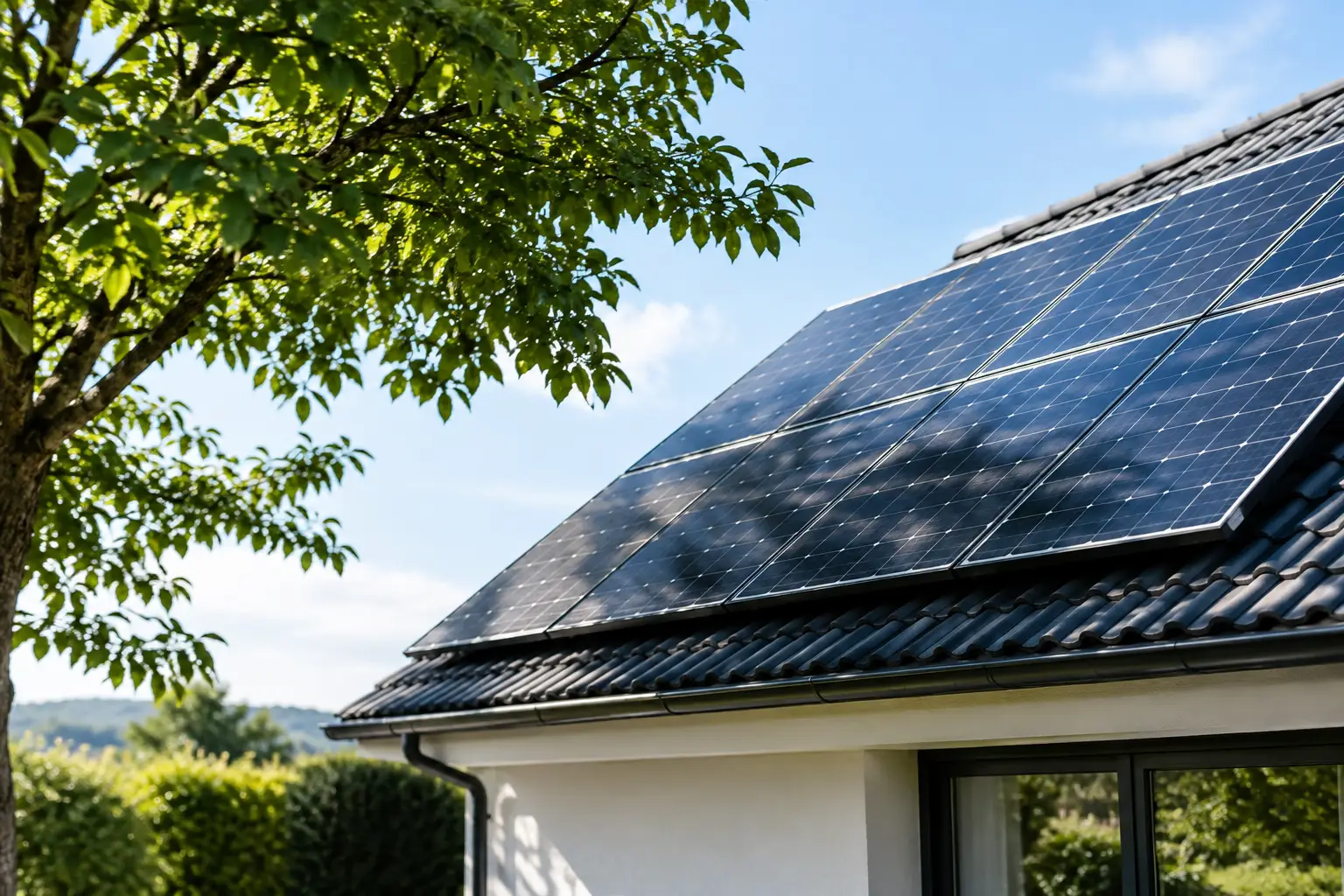
A few hours of daily shade can change a solar proposal far more than most homeowners expect. The best solar panels for shade are not simply the highest-wattage modules on a spec sheet. They are part of a system designed to limit losses from trees, chimneys, vents, neighboring homes, and changing seasonal sun angles.
For a partially shaded roof, the right combination of panel design and power electronics can preserve meaningful production. For a roof that stays heavily shaded through the middle of the day, solar may still work, but the economics deserve a more cautious review before you commit.
What makes a solar panel perform better in shade?
Solar cells in a standard panel are electrically connected in groups. When one portion of a panel is shaded, the affected cells produce less current. Without protection, that weaker section can restrict output from a larger part of the panel.
Modern panels use bypass diodes to route electricity around shaded cell groups. This helps, but it does not make the panel immune to shade. A bypass diode limits the damage from a shaded section; it does not replace the energy that section would have produced in full sun.
The strongest panel choices for mixed-light conditions typically share a few design characteristics: multiple bypass diodes, split-cell or half-cut-cell construction, and high-quality cell manufacturing. Half-cut panels divide cells into two sections, so shade across the lower or upper portion of a module may affect less of its total output than it would on an older full-cell design.
Cell technology matters as well. N-type solar cells, including TOPCon and heterojunction designs, can offer strong efficiency, lower degradation, and favorable performance in warm conditions. Those benefits can improve annual production, but they should not be mistaken for a cure for severe shade. System architecture remains just as important.
Best solar panels for shade: start with the system design
For most shaded residential roofs, microinverters or DC power optimizers matter more than a small difference between two premium panel models.
A traditional string inverter connects many panels into a series circuit. If shade cuts production on one panel, it can reduce the output of other panels in that same string. Modern string inverters manage this better than older equipment, but they still work best when panels receive similar amounts of sunlight.
Microinverters place a small inverter at each panel. Every panel converts its own DC electricity to usable AC power independently. When a branch shades one module, the remaining modules can continue operating closer to their potential. This is often the most practical approach for roofs with irregular, moving shade or multiple roof planes.
DC optimizers are another effective option. They are installed at each panel but work with a central string inverter. Optimizers allow panel-level power management and monitoring, while retaining a larger inverter installed at ground level or near the electrical equipment. They can be a good fit when shade is moderate and a homeowner wants panel-level visibility without choosing a microinverter system.
Neither option creates extra sunlight. Both can reduce the way one underperforming panel affects the rest of the array. That distinction is central to making a sound decision.
The best configuration for light, moderate, and heavy shade
Light shade - such as a small chimney shadow in early morning or late afternoon - may only require careful panel placement and a modern string inverter. Moving a panel a few feet away from an obstruction can be more valuable than upgrading to a more expensive module.
Moderate or shifting shade - such as shadows from mature trees, dormers, utility lines, or nearby structures - generally favors premium half-cut panels paired with microinverters or optimizers. This is where panel-level electronics often earn their cost through higher production and simpler troubleshooting.
Heavy midday shade is different. If a large tree canopy blocks the roof when solar production is normally highest, even the best equipment will have limited output. In some cases, selective tree trimming, a smaller array on the clearest roof plane, a ground-mounted system, or waiting until roof conditions change is the more financially responsible answer.
Panel features worth paying for
When comparing proposals, focus on features that affect real-world production and long-term ownership rather than marketing labels such as “shade resistant.” No panel should be sold as shade-proof.
High module efficiency is valuable when usable roof area is limited. A more efficient panel generates more power per square foot, which can let an installer place the required system size on the sunniest portions of the roof. Efficiency does not necessarily mean better shade recovery, but it can reduce the need to place panels in marginal locations.
Half-cut cell construction is now common in quality residential modules and is a sensible baseline for shade-prone roofs. Look for panels with a strong product warranty, a clear performance warranty, and a manufacturer with an established US service presence. Solar is a long-term investment, so warranty support matters as much as the stated wattage.
Consider the panel’s temperature coefficient, especially in hot US markets. Panels lose output as temperatures rise, and lower temperature-related losses can improve summer production. This is not a shade feature, but it helps protect annual energy yield when rooftop conditions are demanding.
Some premium modules use shingled-cell designs or alternative cell layouts that can reduce losses from certain shadow patterns. These designs can perform well, but homeowners should ask for projected annual production from the complete system rather than assuming a particular cell layout will deliver a dramatic advantage.
Do not buy based on panel wattage alone
A 450-watt panel is not automatically a better choice than a 400-watt panel. Wattage is a laboratory rating under standardized test conditions. It does not account for a tree shadow at 2 p.m., roof orientation, local weather, dirt buildup, or the performance of the inverter system.
Instead, compare proposals using estimated first-year production in kilowatt-hours, system size in kilowatts, and the assumptions behind the estimate. A responsible proposal should show how shade was modeled and whether the installer performed a site assessment using aerial imagery, on-site measurements, or dedicated shade-analysis tools.
Ask where the system is expected to lose sunlight and when those losses occur. Morning shade can be less damaging than afternoon shade in some utility-rate structures, while midday shading usually has a larger effect on total annual output. If your utility has time-of-use rates, the value of electricity produced at different times can also affect savings.
Questions to ask an installer about a shaded roof
Before signing a contract, ask the installer to explain the shade plan in plain language. You should know which roof planes will receive panels, which obstructions affect each area, and why the proposed inverter design is appropriate.
Request answers to these practical questions:
- What percentage of annual solar access does each proposed panel location receive?
- Are any panels placed where shade will regularly affect midday production?
- Why is a string inverter, optimizer system, or microinverter system recommended for this roof?
- Can the proposal show estimated production losses from shade separately from other losses?
- Would tree trimming, panel relocation, or a different roof plane improve the financial result?
A strong installer will not avoid these questions or promise that technology eliminates shade. They will explain the trade-offs between equipment cost, expected production, roof constraints, and your household’s energy goals.
When solar is still worth it on a shaded property
Shade does not automatically disqualify a home from solar. A roof may have several clear areas even when the property feels wooded, and a well-designed smaller system can still reduce utility purchases substantially. High electricity rates, strong local incentives, and a household with consistent daytime use can improve the case.
However, homeowners should be especially careful with broad savings claims when annual solar access is low. If an array must be oversized to offset shade losses, the added equipment may lengthen the payback period. If trees are likely to grow further or a neighboring building project could block a key roof plane, account for that risk before financing the system.
The right solar decision begins with an accurate shade assessment, not a brand name. Choose quality, high-efficiency panels with modern cell construction, then pair them with power electronics suited to your roof. A proposal that clearly shows the limits of your site is often the one most likely to deliver the results you expect.