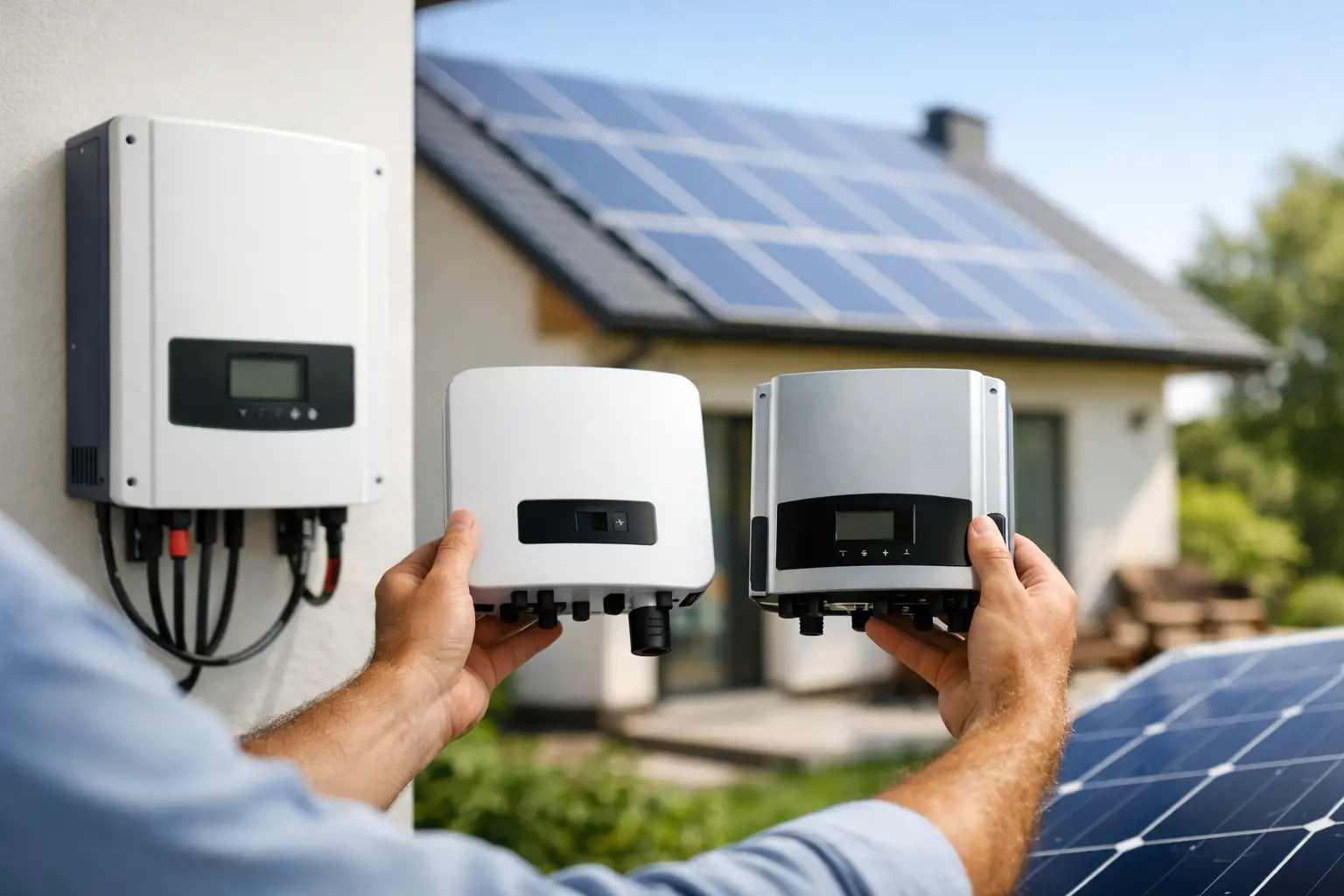
A solar inverter may occupy a small section of your proposal, but it controls how well your system performs every day. Panels produce direct current electricity, while your home and utility grid use alternating current. The inverter makes that conversion, tracks production, manages safety shutoffs, and often determines how easily you can add batteries later. Knowing how to choose solar inverters helps you compare proposals on more than panel count and headline price.
For most homeowners, the right decision is not about finding one universally "best" inverter brand or technology. It is about matching the inverter to your roof layout, shading, electric use, battery goals, local utility requirements, and budget. A lower-priced option can be the practical choice on a simple, sunny roof. A more flexible design can be worth the added cost when your roof has several angles, frequent shade, or plans for future expansion.
Start With Your Roof and Electricity Needs
Before comparing inverter models, establish what the system needs to do. Review at least 12 months of electricity bills, noting annual consumption and seasonal peaks. A household with high summer air-conditioning demand has a different production profile than one with high winter heating loads or a recently purchased electric vehicle.
Your roof matters just as much. A large, unshaded, south-facing roof generally gives an installer broad flexibility. A roof split between east, west, and south sections, or one affected by trees, chimneys, dormers, and vent pipes, calls for closer attention to inverter design. Shade does not need to cover a panel all day to affect output. A brief shadow during high-production hours can matter over the life of the system.
Ask the installer to explain how their proposed inverter handles separate roof planes and shaded modules. The answer should relate directly to your home, not rely on a generic claim that one technology is always superior.
Understand the Three Main Solar Inverter Designs
Residential systems generally use string inverters, microinverters, or a string inverter paired with DC optimizers. Each has valid applications.
String inverters
A string inverter connects a group of solar panels in series to one central inverter, usually mounted near the electrical panel, garage, or exterior service equipment. It is a proven, efficient design and can be a cost-effective choice for an uncomplicated roof with consistent sun exposure.
The trade-off is that panels connected on the same string can be affected by the performance of the lowest-producing panel. Modern string inverters often include multiple maximum power point trackers, called MPPTs, which allow separate panel groups or roof orientations to operate independently. That can solve many, though not all, layout challenges.
String inverter systems also make service access straightforward because the primary electronics are located at ground level. For a homeowner who wants a simple solar system without battery storage or complex roof conditions, this is often a sensible starting point.
Microinverters
Microinverters are installed beneath individual panels and convert electricity from DC to AC at the roof. Because each panel operates independently, microinverters can be particularly useful when a roof has multiple orientations, partial shading, or panels with different production conditions.
They also provide panel-level monitoring. If one panel underperforms, the homeowner and installer can see it in the monitoring platform rather than investigating an entire string. This visibility is valuable, but it should not be mistaken for a guarantee that every issue will be easy to resolve. Roof-mounted equipment may require roof access for service.
Microinverters typically cost more than a basic string inverter design. The additional expense can be justified on a complicated roof, but it may produce little meaningful benefit on a clear, uniform roof plane.
DC optimizers with a string inverter
DC optimizer systems place electronics at each panel while retaining a central string inverter. Optimizers can reduce the effect of mismatch from shade, orientation, or panel-level variations, while giving homeowners detailed production data.
This approach sits between a traditional string design and a microinverter system in both architecture and cost. It can work well for homes that need panel-level optimization but prefer a centralized inverter. As with microinverters, ask about the service process for any roof-mounted component.
Match Inverter Capacity to the System Design
Inverter capacity is measured in kilowatts, while solar panels are rated in DC watts. These numbers are not always the same, and they should not be expected to match exactly.
Installers often design a system with more panel capacity than inverter AC capacity. This is called a DC-to-AC ratio. For example, a 10 kW DC panel array might use an 8 kW AC inverter. During the brightest periods, the system may reach the inverter's output limit, a process called clipping. That sounds negative, but a reasonable amount of clipping can improve annual energy production and reduce equipment cost because panels rarely operate at their laboratory-rated output for long.
The appropriate ratio depends on your climate, roof direction, local weather, utility rules, and the specific equipment. A west-facing array, for example, may produce later in the day and have a different output curve than a south-facing array. Ask for the estimated annual production and the proposed DC-to-AC ratio, then request a plain-language explanation of why the design fits your home.
Do not choose a larger inverter simply because it has a larger number on its label. Oversizing can add cost without increasing meaningful production. Undersizing too aggressively can leave annual generation on the table.
Plan for Batteries and Backup Power Early
Solar panels alone typically shut down during a grid outage for utility-worker safety. If backup power matters to your household, the inverter decision becomes more consequential.
Some inverters are battery-ready, meaning they can work with compatible storage later. Others require additional equipment or a different system architecture. A battery-ready system may cost more upfront, but it can avoid a costly redesign if you expect to add storage within a few years.
Be specific about what you mean by backup. Keeping a refrigerator, internet equipment, lights, and a few outlets running is very different from operating central air conditioning, electric heat, or every circuit in the home. Your inverter, battery capacity, backup panel, and load-management equipment must be designed around the circuits you want to support.
Also ask whether the proposed equipment can provide solar power during an outage without a battery. Some systems offer limited daytime backup capability, but operating conditions and available power are restricted. It is not a substitute for a properly sized battery backup system.
Evaluate Warranties, Monitoring, and Service Support
A strong warranty is useful only when you understand what it covers and who will handle a problem. Review the inverter warranty length, labor coverage from the installer, exclusions, and whether shipping or diagnostic costs could apply. Many residential inverter warranties run 10 to 25 years, but terms vary substantially by manufacturer and system type.
Monitoring deserves equal attention. You should be able to view system production through an app or web portal, but the best monitoring arrangement also gives your installer access to diagnose faults. Confirm whether monitoring is included for the life of the system, whether it requires a reliable home internet connection, and what happens if the manufacturer changes its software platform.
The installer is often the most important part of the service equation. Ask who responds when production falls, how they determine whether a problem is caused by the inverter, panels, wiring, utility meter, or internet connection, and whether they perform warranty claims on your behalf.
How to Choose Solar Inverters From Competing Proposals
When comparing proposals, look beyond brand names. Request the exact inverter model, quantity, rated AC output, warranty documents, monitoring details, and a production estimate for each design. If one proposal uses microinverters and another uses a string inverter, ask each company to describe the practical benefit for your specific roof and whether that benefit is reflected in the annual production estimate.
Check compatibility with your electrical service and utility interconnection requirements. Older electrical panels, service upgrades, export limits, and local rapid-shutdown rules can influence equipment selection. A qualified installer should account for these items before installation, not present them as a surprise change order later.
The best inverter is the one that fits the home you have and the energy plan you are building. Choose equipment with a clear production rationale, dependable service support, and room to grow if your household's energy use changes. A well-explained proposal is usually a better sign than the proposal with the most technical terms.