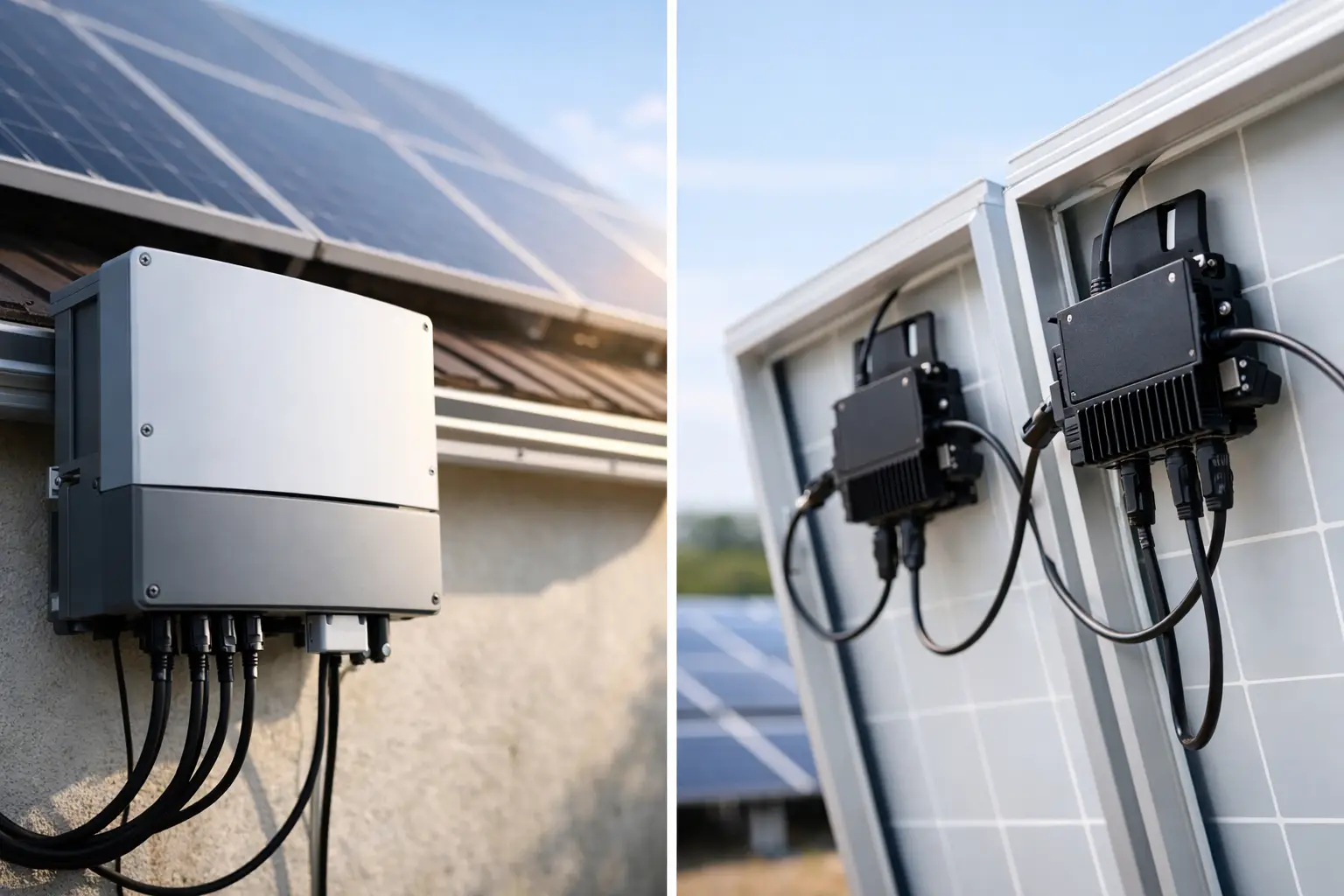
A string inverter vs microinverter decision can affect what your solar system produces, how easily it can expand, and what you may pay for repairs years from now. The right answer is rarely about which technology is universally better. It comes down to your roof, the shade around it, your budget, and how much panel-level visibility matters to you.
For many US homeowners, inverter choice is one of the most consequential design decisions hiding behind the solar proposal. Panel wattage gets attention, but the inverter determines how the electricity from those panels is converted into usable power for your home.
How the two systems work
Solar panels generate direct current, or DC electricity. Your home and the grid use alternating current, or AC electricity. An inverter performs the conversion.
A string inverter is one central unit, usually installed near your electrical panel, garage, or exterior utility equipment. Panels are connected in groups called strings, and the DC electricity from each string travels to that inverter for conversion.
Microinverters are small inverters installed beneath or near each solar panel. Each panel converts its own DC power to AC on the roof, then the AC electricity is combined and sent to your home.
That basic difference drives nearly every trade-off. A string inverter centralizes equipment and typically lowers upfront cost. Microinverters distribute the conversion work across the array, which can improve performance when panels operate under different conditions.
String inverter vs microinverter performance
On a simple, open roof with all panels facing the same direction, a modern string inverter can perform extremely well. If every panel receives similar sunlight, the system has little reason to need panel-by-panel conversion. This makes string inverter systems a practical fit for many straightforward suburban rooftops.
The picture changes when panels experience uneven sunlight. With a traditional string setup, output from a string can be constrained when one or more panels are shaded, soiled, or oriented differently from the others. The precise impact depends on system design and the inverter’s power-point tracking capabilities, but mismatch can reduce production.
Microinverters allow each panel to operate independently. A chimney shadow crossing two panels in the morning should have a smaller effect on the rest of the array than it would in a conventional single-string arrangement. They also work well when a roof requires panels on several planes, such as east, west, south, and a detached garage.
Shade is not the only reason to choose microinverters. Different roof angles, varied panel orientations, and phased additions can all favor a panel-level design. Still, do not assume that a few hours of distant tree shade automatically require microinverters. A qualified installer should model the shade, roof layout, and annual production difference before treating the higher equipment cost as justified.
Upfront cost and long-term value
String inverters generally cost less than microinverters for a comparable system. There is one main inverter rather than an inverter at every panel, and installation can involve less rooftop electronics. For a homeowner focused on the strongest possible return from a clean, unshaded roof, that lower initial price can be compelling.
Microinverters usually increase the equipment and labor cost. The premium varies by market, equipment brand, roof complexity, and system size, so a proposal should show the actual dollar difference instead of relying on broad claims. The value case is strongest when their production advantages solve a real site-specific problem.
Replacement timing also matters. A central string inverter may need replacement during the life of the solar panels, even when panel production remains strong. Microinverters are designed for long service life and commonly carry lengthy product warranties, but a failure can require a technician to access the roof and remove a panel. One system concentrates future maintenance in an accessible location; the other spreads risk across many components.
Neither arrangement is maintenance-free or failure-proof. Ask for the manufacturer warranty, labor warranty, and the installer’s process for diagnosing and replacing failed equipment. A long equipment warranty is useful, but a homeowner also needs to know who will handle the service call.
Monitoring, reliability, and safety
Microinverter systems usually provide panel-level monitoring. Through an app or web portal, you can see whether one panel is producing less than its neighbors. That is useful for identifying a failed component, a new shade source, or unusual performance before it becomes a larger annual production loss.
String inverter monitoring is often system-level, although many current models can track separate strings. For a simple roof, that visibility may be completely sufficient. You do not need a data dashboard for every panel to know whether a well-designed system is delivering expected energy.
Reliability is more nuanced than “one inverter is safer than many.” A string inverter creates a single point of failure: if it stops operating, the entire system may stop producing until it is repaired. Microinverters avoid that all-or-nothing outcome because other panels can keep generating if one unit fails. On the other hand, a microinverter system has more electronic devices exposed to rooftop heat over time.
Both system types must meet applicable rapid-shutdown requirements and local electrical codes. Microinverters inherently support module-level shutdown, while string inverter systems can use listed rapid-shutdown equipment or panel-level devices. Treat safety as a design and code-compliance question, not a marketing shortcut. Your installer should clearly explain how the proposed system meets the requirements in your jurisdiction.
The middle option: power optimizers
Homeowners often hear only two choices, but power optimizers create a useful third category. Optimizers are installed at individual panels, similar to microinverters, but they condition DC power before sending it to a central string inverter.
This setup can offer panel-level optimization and monitoring while retaining a central inverter. It may be a strong option for roofs with moderate shading or multiple orientations. It also retains a rooftop component at each panel, so it does not eliminate the service-access trade-off. Compare it on actual production estimates, installed price, warranty coverage, and equipment design rather than assuming it is automatically the compromise choice.
Which inverter is likely right for your roof?
A string inverter often makes sense when your panels will sit on one or two similarly oriented, unshaded roof planes and keeping initial cost low is a priority. It can also be attractive when you prefer major inverter equipment at ground level or in a garage where servicing is more direct.
Microinverters often make sense for roofs with recurring shade, complicated geometry, many orientations, or a plan to add panels later. They can also appeal to homeowners who want detailed panel-level monitoring and prefer that a single equipment failure not pause the entire system.
Expansion deserves a careful conversation. Adding panels to an existing string inverter system can be limited by the inverter’s capacity, voltage range, and available roof layout. Microinverters can make additions more flexible, but the existing electrical service, utility interconnection agreement, and current code rules still control what is possible. No inverter choice guarantees a simple future expansion.
Questions to ask before approving a proposal
Ask each installer to explain why the selected inverter fits your specific roof rather than simply naming their preferred brand. Request an annual production estimate for the proposed equipment, and ask whether shade, roof orientation, or clipping assumptions were included.
You should also ask what happens if the inverter fails, which warranty covers labor, whether monitoring is included without ongoing fees, and how the design supports rapid shutdown. If you are comparing two proposals, make sure the quoted system sizes, panel counts, annual production estimates, and warranty terms are aligned. A lower price may reflect a smaller system or a different production assumption, not just a less expensive inverter.
The best solar design is the one that turns your actual roof into dependable household energy at a price that makes sense for your goals. Before choosing, have a solar professional walk you through the site-specific production and service trade-offs in plain numbers. That conversation is more valuable than a generic claim that one inverter type always wins.