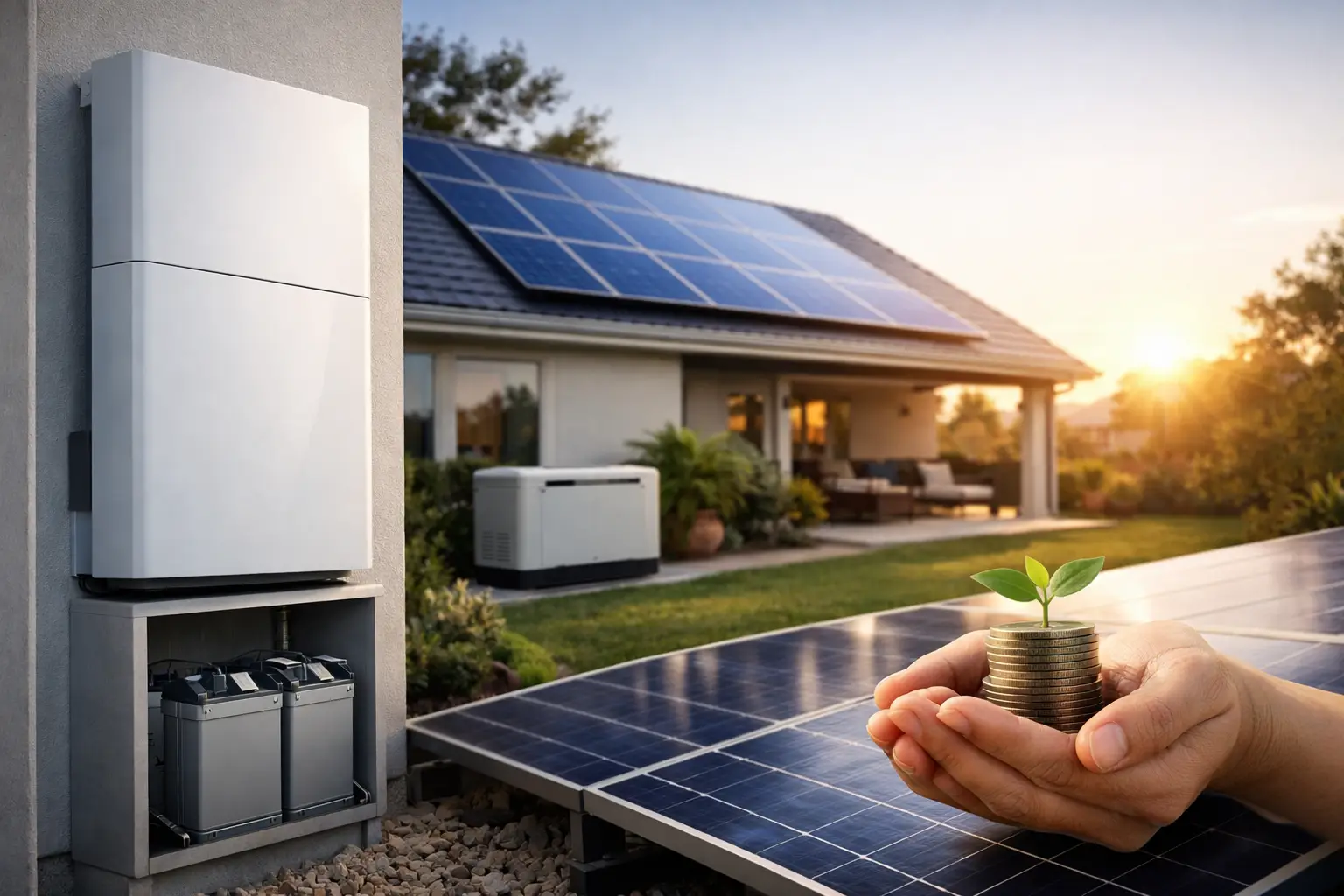
A refrigerator full of food, a working internet connection, a sump pump, and a few lights can change an outage from a major disruption into an inconvenience. That is the practical case for a solar battery backup for home. It stores electricity for the hours when the grid is unavailable or utility rates are highest, giving homeowners more control over how their solar power is used.
A battery is not automatically the right addition to every solar project. Its value depends on your outage exposure, electricity rate structure, solar system size, household priorities, and budget. The best decision starts with a clear understanding of what a battery can power, what it cannot, and how the system will operate when the grid goes down.
What a home solar battery actually does
Solar panels produce electricity when sunlight reaches the array. Without a battery, most grid-connected systems use that electricity in the home first and send surplus production to the utility grid. At night, or whenever solar production does not cover demand, the home draws power from the grid.
A battery changes that flow. It stores excess solar energy for later use. Depending on the system design and local utility rules, the battery may charge from solar, the grid, or both. It can then discharge during an outage, after sunset, or during expensive peak-rate periods.
The critical distinction is backup capability. A standard solar system generally shuts down during a grid outage, even if the sun is shining. This safety requirement protects utility workers repairing power lines. A properly designed battery system can isolate your home from the grid and create a controlled source of backup power from the battery and, in many cases, the solar array.
Solar battery backup for home: what can it run?
The answer is determined by two separate specifications: battery capacity and power output. Capacity, measured in kilowatt-hours (kWh), is the amount of energy stored. Power, measured in kilowatts (kW), is how much electricity the battery can deliver at one time.
Think of capacity as the size of a fuel tank and power as the engine's ability to handle demand. A battery with ample capacity may still struggle if too many high-demand appliances start at once. Central air conditioning, electric resistance heat, electric water heaters, dryers, ovens, pool pumps, and EV chargers can create large loads that require careful planning.
For this reason, many homeowners choose an essential-loads backup design. The installer places selected circuits on a backup panel, often including refrigeration, kitchen outlets, lighting, internet equipment, garage doors, a furnace blower, medical equipment, and a sump pump. This approach can provide meaningful outage coverage without paying to back up every appliance in the house.
Whole-home backup is possible, but it requires a more detailed load analysis. Larger homes, all-electric homes, and households that want to run central HVAC during an outage may need multiple batteries, load-management equipment, or both. Smart controls can temporarily limit large appliances so the battery is not overloaded.
Start with outage goals, not a battery size
The right system begins with a straightforward question: what must continue running, and for how long? A homeowner who experiences brief, occasional outages has different needs from someone in a storm-prone area where power can be out for days.
Create a realistic list of essential circuits and estimate their daily energy use. A refrigerator may use modest energy over a full day but needs enough starting power. A sump pump may use little energy when idle but becomes non-negotiable during heavy rain. Internet equipment uses relatively little power, while HVAC can quickly become the dominant load.
Your installer should review at least 12 months of utility usage, your planned solar production, and the specific equipment you want to support. They should also discuss seasonal realities. Solar production is often lower during winter storms, while heating loads may be higher. In hot climates, summer solar output can be strong, but air-conditioning demand may also be substantial.
A battery is not an unlimited generator. Conserving energy during an outage extends runtime. Running the dishwasher, charging an EV, or using an electric dryer while operating on backup can drain stored energy quickly. A well-designed system makes these trade-offs visible rather than leaving homeowners to discover them during an emergency.
How solar recharges a battery during an outage
Many homeowners assume a battery provides a fixed number of backup hours. That can be true overnight, but solar can materially extend backup duration during daylight. Once the system separates from the grid, solar panels may continue supplying the home and recharging the battery, provided the equipment is designed for that operating mode.
Production will vary with weather, roof orientation, season, shading, and household demand. On a clear day with moderate loads, solar may recharge the battery and keep essential circuits running well beyond the initial stored energy. During several cloudy days, the battery may not fully recharge, and energy management becomes more important.
This is why battery sizing cannot be separated from solar design. Adding storage to an undersized array may improve outage resilience, but it may not produce enough energy to recharge consistently. Conversely, a larger solar system without adequate storage may export excess electricity when the grid is working but offer limited overnight backup during an outage.
Costs, savings, and the value of resilience
A home battery is a major equipment investment. Installed cost is influenced by battery capacity, output rating, number of units, electrical upgrades, backup panel configuration, labor, permitting, and whether it is installed with a new solar system or added later. Whole-home backup typically costs more than an essential-loads design because of the additional storage and electrical work involved.
The financial return depends heavily on your local utility structure. Batteries can offer stronger bill savings where time-of-use rates create a wide difference between lower daytime prices and higher evening prices. They may also help homeowners retain more value from their solar production where export compensation is low.
In areas with favorable net metering, a battery may offer less direct monthly savings. It can still be worthwhile for resilience, but the purchase should be evaluated as an energy-security investment rather than solely as a payback calculation. Homeowners should also ask how their utility handles battery charging and exported stored energy, since program rules differ.
Federal, state, local, and utility incentives may reduce the net cost, but eligibility and funding can change. Confirm current requirements before signing a contract, particularly if you plan to claim a tax credit or participate in a utility demand-response program.
Questions to ask before choosing equipment
Battery brands matter, but system design and installer expertise matter just as much. Before moving forward, ask a solar professional to explain the usable battery capacity, continuous power output, surge capability, warranty terms, expected outage runtime, and which circuits will be backed up.
Also ask whether the proposal includes a critical-load panel, automatic transfer equipment, consumption monitoring, and load controls for large appliances. These components affect how the system performs when it is needed most. If whole-home backup is proposed, request a clear explanation of what happens when HVAC, well pumps, or other high-draw equipment starts.
It is also reasonable to ask about future expansion. Some battery platforms can add capacity later, while others have practical limits. Planning for an electric vehicle, heat pump, pool equipment, or an all-electric kitchen may change the best design today.
When a battery makes the most sense
Storage is especially compelling for homeowners who face frequent outages, rely on well pumps or sump pumps, work from home, use medical devices, or live where utility restoration can take time. It can also be a strong fit for households facing high evening electricity rates or reduced compensation for solar exports.
It may be less urgent for a home with highly reliable grid service, modest electricity rates, and favorable net-metering terms. In that case, putting more of the budget toward solar capacity, insulation, efficient HVAC, or electrical upgrades may produce a better overall result. There is no universal answer, and a credible proposal should show the trade-offs plainly.
The right solar battery backup for home is not the largest battery available. It is the system that protects the loads your household truly depends on, fits the way you use energy, and gives you a clear plan for the next outage before one arrives.