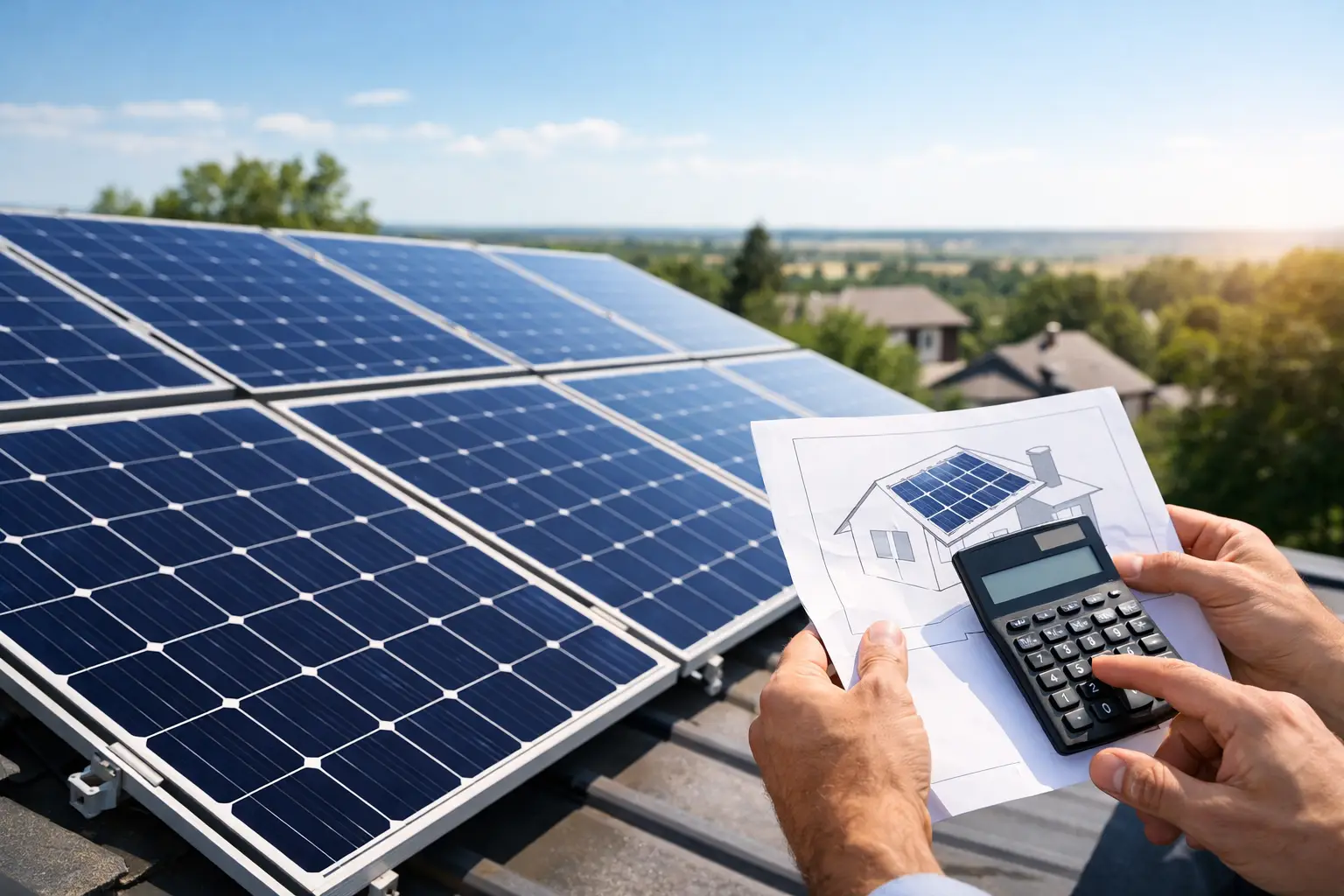
A 4kW solar system is often a practical fit for a modest-electricity-use home, but the answer to “how many solar panels do I need for a 4kW system” is not one fixed number. With common residential panels, the answer is usually 8 to 11 panels. The exact count depends on each panel’s wattage, your usable roof area, and how the system is designed around shading and local utility rules.
For most homeowners, the fastest calculation is simple: divide 4,000 watts by the wattage of the panel you are considering. A qualified installer should then refine that starting point using your roof, annual electricity consumption, and expected solar production.
How Many Solar Panels for a 4kW System?
A 4kW system has 4,000 watts of direct-current, or DC, solar capacity. Solar panels are rated in watts, so the panel count comes from dividing 4,000 by the rated output of one panel.
| Panel wattage | Panels needed | System size | |---|---:|---:| | 350 watts | 12 panels | 4.20kW | | 400 watts | 10 panels | 4.00kW | | 425 watts | 10 panels | 4.25kW | | 450 watts | 9 panels | 4.05kW | | 500 watts | 8 panels | 4.00kW |
A 400-watt panel is common in residential proposals, which makes 10 panels the cleanest example of a 4kW system. However, installers do not always design to an exact 4,000-watt total. Nine 450-watt panels create a 4.05kW array, while 10 425-watt panels create a 4.25kW array. That small difference may be worthwhile if it better uses the available roof space or improves projected savings.
The system size shown on a proposal is usually the DC size of the panel array. Your inverter converts that solar electricity to alternating current, or AC, for household use. Because DC and AC ratings are different measurements, do not assume a 4kW solar array will continuously deliver 4kW of usable AC power. Temperature, sunlight angle, equipment losses, and inverter settings all affect real-time output.
Use the Panel-Count Formula First
The calculation is:
4,000 watts ÷ panel wattage = number of panels needed
If the result is not a whole number, round up when your goal is to reach at least 4kW. For example, 4,000 divided by 370 equals 10.8, so you would need 11 370-watt panels. That would produce a 4.07kW array.
Panel wattage is not the same thing as panel quality. A 450-watt panel may be physically larger than a 400-watt panel, and it may not be the better choice for every roof. Roof shape, vent placement, fire setbacks, and local code requirements can make a slightly lower-wattage panel more workable. The best design is the one that produces the most useful electricity from your available roof, not necessarily the one with the fewest panels.
How Much Roof Space Does a 4kW System Need?
Most modern residential panels take up roughly 18 to 22 square feet each. A 4kW system with 10 panels may therefore require about 180 to 220 square feet of clear roof area before accounting for required setbacks and space around roof obstructions.
That does not mean a 200-square-foot section of roof will always fit 10 panels. Solar panels must be arranged in usable rows and columns. Chimneys, skylights, plumbing vents, dormers, and ridges can break a seemingly large roof plane into smaller sections. Some jurisdictions also require pathways for fire access, which can reduce usable space further.
Orientation matters as well. In much of the United States, a south-facing roof generally produces the most annual electricity, but east- and west-facing arrays can still make financial sense. West-facing panels may generate more power later in the afternoon, when household demand and utility rates can be higher. A good design considers when your home uses electricity, not just the maximum possible annual production.
A 4kW System Is Not Always the Right Size
Panel count answers only one design question. The more useful question is whether a 4kW system matches your electricity needs.
A 4kW residential solar system may produce roughly 5,000 to 7,000 kilowatt-hours per year in many parts of the country. Production can be higher in sunny Southwest markets and lower in northern states, cloudy climates, heavily shaded locations, or roofs with less favorable orientation. Local weather patterns and roof conditions matter more than national averages.
Compare that estimated annual production with the electricity usage on your utility bills. If your home uses 6,000 kWh per year and the proposed system is expected to produce 5,800 kWh, it may cover much of your annual use. If your household uses 12,000 kWh per year, a 4kW system will likely offset only part of the bill.
Partial offset is not necessarily a poor decision. A homeowner may intentionally install 4kW because of budget limits, limited roof space, or plans to add another array later. On the other hand, sizing too small can be frustrating if you expect to buy an electric vehicle, add a heat pump, install a pool, or replace gas appliances with electric equipment in the next few years.
Factors That Can Change the Recommended Panel Count
A panel count that looks right on paper can change during a site assessment. Shade is one of the biggest reasons. Even limited shade from a tree, chimney, or neighboring structure can reduce production during key hours. Installers may use module-level power electronics, such as microinverters or optimizers, to help manage uneven panel performance, but those tools do not make persistent shade disappear.
Your utility’s billing structure also affects system sizing. Net metering policies, export compensation rates, and time-of-use charges determine how valuable excess daytime generation is. In some areas, producing more electricity than your home can use at midday provides a lower credit than avoiding electricity purchases in the evening. That can change the economics of a larger array or create a stronger case for battery storage.
Equipment availability can matter, too. A proposal based on 10 400-watt panels may shift to nine 450-watt panels if the selected equipment changes. The total system capacity may remain nearly the same, but the layout, appearance, and electrical design may be different.
Finally, do not overlook roof condition. If your roof is nearing the end of its life, replacing it before solar installation is usually less expensive and less disruptive than removing and reinstalling panels later. A 4kW system is a long-term home improvement, so the roof below it should be ready for the same timeline.
Should You Add a Battery to a 4kW Solar System?
A battery does not change how many panels you need for a 4kW array, but it can change how much of that solar energy you use at home. Without a battery, excess midday generation typically flows to the grid. With a battery, some excess energy can be stored for evening use or backup power, depending on the equipment and system configuration.
Battery capacity should be sized separately from panel capacity. A 4kW solar array describes how quickly the panels can produce electricity under ideal conditions. A battery is measured in kilowatt-hours, which describes how much energy it can store. Backup goals, essential loads, utility rates, and outage frequency should guide that decision.
For example, a homeowner who mainly wants lower utility bills may prioritize solar production and favorable export credits. A homeowner who needs to run refrigeration, internet equipment, lights, and a well pump during outages may place greater value on battery capacity and backup-power design. Those are different objectives, even when the solar array size is the same.
Questions to Ask Before Approving a 4kW Quote
Ask the installer for the panel wattage, total DC system size, estimated first-year production, and expected annual offset of your current electricity use. Request a roof layout so you can see where each panel will sit and whether any panels are expected to receive shade.
Also ask what assumptions are built into the savings estimate. Utility rates can rise, but solar savings should not be presented as a guarantee without clear assumptions. Confirm whether the proposal includes permits, interconnection, monitoring, roof work if needed, and any electrical-panel upgrades. A lower equipment price can become less attractive if essential project costs are excluded.
If two proposals have different panel counts, compare the total system size and estimated production rather than judging the count alone. Ten 400-watt panels and nine 450-watt panels are close in capacity. The better proposal may come down to warranty terms, roof layout, production estimate, installer workmanship, and the clarity of the contract.
A 4kW system can be a disciplined starting point for solar, especially when it is based on real utility usage and a site-specific design. The right panel count should leave you with more than a neat number on a proposal - it should give you a system that fits your roof, your budget, and the way your household will use energy years from now.